
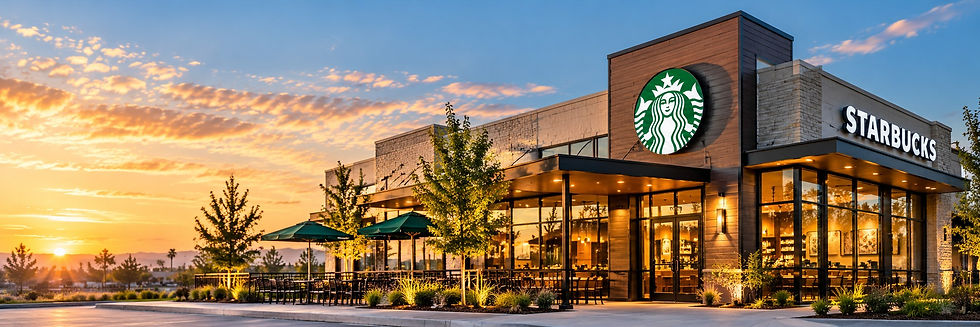
How Do I Sell a Starbucks Triple Net (NNN) Property?
Selling a Starbucks Triple Net (NNN) property for the strongest possible price starts with strategic positioning and exposure to the right buyers. Highwater Partners, led by Mercedes Shaffer, helps NNN property owners nationwide maximize value through specialized NNN expertise, national marketing, direct exposure to NNN and 1031 exchange buyers, and the additional investor reach of The Commercial Real Estate Deal Room on YouTube. Our objective is to position your Starbucks property around its strongest attributes, create maximum qualified buyer exposure and competition, and help you achieve the highest price and strongest terms the market will support.
Starbucks is one of the most recognizable names in commercial real estate, but the logo on the building does not determine what a buyer will pay for your property. Sophisticated investors will look at the actual lease, remaining term, rent structure, location, site quality, building configuration and long-term value of the underlying real estate. The right sale strategy identifies those strengths and potential objections before the property reaches the market—and then positions the opportunity for the buyer segments most likely to value it.
How Can I Get the Highest Price for My Starbucks NNN Property?
Getting the highest price the market will support requires more than selecting an asking cap rate and placing the property on a listing platform. A Starbucks property should be evaluated first to determine which characteristics are most likely to create value for buyers and which could narrow the buyer pool, then marketed around the attributes that distinguish it from other Starbucks and net lease opportunities.
Starbucks' brand recognition can be an important advantage. As of June 2026, Starbucks reported more than 18,000 coffeehouses in North America, including both company-operated and licensed locations. The company has also reported improving comparable-store performance under its “Back to Starbucks” strategy. At the same time, Starbucks continues to actively manage its real estate portfolio, including closing locations that it determines do not have a path to acceptable financial performance. That makes the quality of the individual property especially important.
For a seller, the takeaway is straightforward: Starbucks may get a buyer's attention, but the individual property still has to justify the price. A well-located freestanding Starbucks with strong access, a drive-thru, attractive lease economics and substantial remaining term may appeal to a different—and potentially broader—buyer pool than a location with a shorter lease, weaker site characteristics or less adaptable real estate.
That is why we evaluate the entire asset before determining how it should be priced and positioned. Owners who want a deeper explanation of the process can review What Is My Triple Net (NNN) Property Worth?.
What Will Buyers Evaluate When I Sell My Starbucks Property?
Buyers will evaluate the Starbucks tenancy, but they will also look closely at the lease, income, location and physical real estate supporting that income. The strongest marketing strategy anticipates those questions before buyers begin underwriting the property.
One of the first documents to review is the lease itself. Sellers should understand exactly which entity is named as the tenant and responsible under the lease rather than assuming that every property displaying the Starbucks name has identical lease credit or economics. Remaining firm lease term also matters. Renewal options can be valuable, but an option controlled by the tenant is not the same as guaranteed remaining lease term.
Rent and contractual increases are another part of the story. Buyers are evaluating today's NOI, but they are also looking at how income changes over their anticipated ownership period and whether the rent appears sustainable relative to the property and market. The allocation of responsibilities between landlord and tenant—including roof, structure, taxes, insurance, maintenance and capital obligations—can also influence how investors perceive the income stream.
These differences help explain why two Starbucks properties generating similar annual rent can trade differently. For a seller, the goal is to identify the attributes that support value, address foreseeable buyer concerns and present the property in a way that makes its investment story easy to understand.
Why Does the Location and Real Estate Matter So Much for a Starbucks?
Location and underlying real estate can materially affect what buyers are willing to pay for a Starbucks property because they influence both the durability of the existing tenancy and the property's value if Starbucks eventually leaves. A buyer is purchasing a lease-backed income stream today, but also a physical piece of commercial real estate that may need to perform beyond the current lease.
For Starbucks properties, site configuration can be particularly important. Drive-thru capability, traffic patterns, visibility, ingress and egress, frontage, parking, surrounding retail, nearby employment and residential density can all affect how buyers view the real estate. A strong corner or outparcel in an established retail corridor may have meaningful value independent of the Starbucks tenancy.
Building configuration matters as well. A freestanding drive-thru building on a well-positioned parcel may provide different re-leasing or redevelopment possibilities than an inline location or highly specialized site. Buyers frequently consider what another tenant might pay, how easily the building could be adapted, and what the land might be worth if Starbucks were no longer there.
This is especially relevant today because Starbucks is simultaneously investing in its coffeehouse portfolio and evaluating individual locations. The company has been upgrading coffeehouses as part of its broader strategy while also closing locations it determines do not meet its financial or customer-experience objectives. For sellers, that reinforces the importance of marketing the real estate as well as the Starbucks name.
For a broader discussion of these factors, see our Guide to Selling QSR Triple Net (NNN) Real Estate.
How Should a Starbucks NNN Property Be Marketed Nationally?
A Starbucks NNN property should be marketed beyond its immediate geographic area because the strongest prospective buyer may live hundreds or thousands of miles from the property. Private investors, family offices, experienced NNN investors and buyers completing 1031 exchanges routinely evaluate single-tenant properties outside their home markets.
This is where seller representation becomes more than simply putting the property online. At Highwater Partners, our objective is to identify the buyer segments most likely to value the specific Starbucks opportunity and then create broad, targeted exposure around the attributes that matter to those investors. A long-term passive-income buyer may focus heavily on lease duration and responsibilities, while another investor may place greater value on the site's location, drive-thru configuration and long-term residual real estate.
1031 exchange buyers can be particularly important because they are often working within defined acquisition timelines and may be evaluating replacement properties nationally. A recognizable tenant such as Starbucks can attract their attention, but the lease, location, pricing and financing still have to fit their objectives.
The purpose of broad exposure is not simply to accumulate inquiries. It is to reach enough of the right buyers to test the market effectively and, when possible, create competitive tension. That can strengthen the seller's negotiating position not only on price, but also on due diligence, financing contingencies, closing certainty and other terms.
This is why national buyer exposure matters when selling a Triple Net (NNN) property. Highwater's direct national marketing is supplemented by Mercedes Shaffer's Commercial Real Estate Deal Room, giving us another investor-facing platform through which we continually engage with an audience interested in NNN properties, 1031 exchanges and passive commercial real estate.
When Should I Sell My Starbucks NNN Property?
The right time to sell a Starbucks property depends partly on what is happening inside the lease, not simply what is happening in the broader investment market. Remaining lease term, upcoming options, scheduled rent increases, potential tenant decisions and known property issues can all change how buyers perceive the opportunity.
This is why timing should ideally be evaluated before the owner feels compelled to sell. A property with substantial firm lease term may appeal to a broader pool of passive investors and lenders than the same property several years later. Conversely, there may be circumstances where an upcoming rent increase, lease clarification, completed property improvement or other event strengthens the marketing story.
Starbucks' current portfolio strategy adds another consideration. The company has recently reported improving operating momentum and has outlined substantial long-term growth ambitions in the United States, while continuing to review individual coffeehouses and close locations it believes lack an acceptable path forward. For an owner, broad corporate momentum is relevant, but it does not replace an analysis of the specific location and lease.
The decision should therefore be based on the intersection of the property's lease timeline, real estate quality, Starbucks' position at that particular location and current buyer demand. Waiting is not automatically better simply because another year of rent will be collected; in some situations, the reduction in remaining lease term can become more important to buyers than the benefit of waiting.
What Triple Net (NNN) Sellers Often Miss
One of the biggest mistakes a Starbucks property owner can make is assuming that the tenant name tells buyers everything they need to know. It does not. Buyers will review the actual tenant entity, firm lease term, renewal options, rent schedule, landlord obligations and other provisions of the lease, and those details can materially affect underwriting.
Owners also sometimes underestimate the importance of the physical site. The drive-thru, access, traffic pattern, parcel configuration and surrounding trade area can influence both the performance of the existing location and the property's residual value. Strong underlying real estate can provide a buyer with another reason to pursue the asset beyond the current income stream.
Timing is another issue sellers can overlook. A property that is highly marketable with substantial firm lease term may face a different buyer pool after several more years have elapsed. Owners considering a sale should understand how remaining lease term can affect the value of a Triple Net (NNN) property before simply deciding to hold for another year or two.
Finally, sellers can underestimate the importance of distribution. A Starbucks property may be located in one city, but its buyer pool can be national. Restricting exposure to a local network risks missing investors elsewhere who may place greater value on that particular combination of tenant, income, lease and real estate.
Bottom Line
Selling a Starbucks Triple Net (NNN) property for the strongest possible outcome requires combining the power of a highly recognizable tenant with a clear understanding of the individual lease, remaining term, site quality and underlying real estate. Highwater Partners' role is to identify what makes the property compelling, position it appropriately, expose it to qualified NNN and 1031 buyers nationally, and create the strongest negotiating environment the market will support.
Frequently Asked Questions
How do I get the highest price for my Starbucks NNN property?
The goal is to position the property around the characteristics the strongest buyers are most likely to value and then expose it to the broadest appropriate buyer pool. That requires evaluating the lease, remaining term, income, site and underlying real estate before establishing pricing and marketing strategy, rather than assuming the Starbucks name alone will produce the best result.
How much is my Starbucks NNN property worth?
The value of a Starbucks NNN property cannot be determined from the tenant name or rent alone. Buyers will consider the actual lease, remaining term, contractual rent increases, landlord obligations, location, site characteristics, underlying real estate, financing and current investor demand before determining what they are willing to pay.
Does the Starbucks name make my property more valuable?
Starbucks' national recognition can increase investor awareness and attract buyers looking for recognizable single-tenant real estate, but the brand alone does not determine value. The specific lease, location, remaining term, rent and real estate still matter, particularly because buyers are underwriting both the durability of the income and the property's longer-term residual value.
Does a drive-thru matter when selling a Starbucks property?
A drive-thru can be an important site characteristic because it may contribute to the functionality and long-term adaptability of the real estate, but its value depends on the specific property. Buyers may also evaluate access, traffic circulation, parcel size, visibility, zoning and whether the configuration would appeal to future replacement users.
When should I sell my Starbucks NNN property?
The best timing depends on the specific lease and property. Owners should consider remaining firm term, upcoming options or rent changes, potential tenant decisions, property condition and current buyer demand before deciding whether to sell now or wait. Ideally, that analysis occurs well before a lease milestone begins narrowing the buyer pool.
Why does national exposure matter when selling a Starbucks property?
National exposure matters because NNN and 1031 exchange investors frequently purchase properties outside their home markets. Reaching qualified buyers across the country can expand the potential buyer pool and increase the opportunity for competitive interest, which can improve the seller's negotiating position on price and transaction terms.
Related Triple Net (NNN) Resources
When Is the Best Time to Sell a Triple Net (NNN) Property?
How to Choose the Best Triple Net (NNN) Broker
Let's Connect
If you own a Starbucks Triple Net (NNN) property and are considering selling, Highwater Partners can help you evaluate its potential value, determine the right timing and positioning strategy, and identify the buyer segments most likely to value the opportunity. Before deciding when or how to go to market, a confidential property review can help you understand how your lease, location and real estate may influence the sale—and how we would position the property nationally to pursue the strongest possible outcome.
About Mercedes Shaffer
Mercedes Shaffer is the Founder of Highwater Partners, a commercial real estate advisory firm specializing in Triple Net (NNN) investments, 1031 exchanges, multifamily investment properties, and single-tenant net lease real estate throughout the United States. Together with her brokerage platform, her team brings more than 250 years of combined commercial real estate experience and more than $18 billion in transaction experience.
Mercedes advises private investors, family offices, developers, and institutional investors on the acquisition, disposition, valuation, and exchange of investment real estate. Her expertise includes tenant credit analysis, lease structure, cap rates and valuation, 1031 exchange strategy, market and location fundamentals, and the evaluation of risk in Triple Net investments.
In addition to her advisory work, Mercedes is also the creator and host of the Commercial Real Estate Deal Room, an educational platform focused on helping investors understand Triple Net real estate, 1031 exchanges, lease and tenant risk, valuation, and the transition from management-intensive properties into more passive real estate investments.
Mercedes is known for an analytical approach that goes “beyond the cap rate” and the glossy brochure. Rather than evaluating an investment solely by its advertised yield or the name on the building, she examines the tenant, lease, underlying real estate, market fundamentals, exit strategy, and the investor's broader objectives.
Her philosophy is straightforward: there is no universally “best” Triple Net property—only an investment whose combination of real estate, income, risk, and long-term strategy may or may not be appropriate for a particular investor. That perspective guides her work across acquisitions, dispositions, 1031 exchanges, and long-term investment strategy.