
How Do I Sell My Jack in the Box Triple Net (NNN) Property?
If you own Jack in the Box Triple Net (NNN) real estate, your goal should be to pursue the strongest market-supported sale price by exposing the property to the broadest appropriate pool of qualified buyers. Highwater Partners combines detailed analysis of the property, tenant, actual lease guarantor, lease economics, location, and underlying real estate with strategic pricing, national NNN buyer outreach, traditional commercial real estate marketing, and access to 1031 exchange investors. Mercedes Shaffer also creates and hosts The Commercial Real Estate Deal Room on YouTube, giving Highwater Partners another direct avenue for engaging investors already interested in NNN real estate, lease analysis, valuation, and passive investment strategy.
Selling a Jack in the Box property successfully requires more than choosing an asking cap rate and placing the property on listing platforms. Jack in the Box operates and franchises restaurants, while the drive-thru and takeout channels are important components of the brand's operating model. Those characteristics make the actual tenant entity, guarantor, lease structure, drive-thru site, access, visibility, and adaptability of the underlying real estate particularly important to buyer underwriting.
What Will Buyers Evaluate in My Jack in the Box NNN Property?
Buyers will evaluate the entire investment—not simply the Jack in the Box name on the building. The strongest seller positioning begins by analyzing the asset through five connected layers: the brand, the guarantor and lease, the income stream, the location, and the underlying real estate.
For a Jack in the Box property, identifying the actual entity responsible for the lease is especially important. Jack in the Box operates through both company-operated and franchised restaurants, so an owner should never assume that brand recognition and lease-credit strength are identical. A lease backed by a corporate entity, a substantial multi-unit franchisee, a regional operator, or another entity can be viewed differently by lenders and investors.
The lease should then be examined for remaining firm term, renewal options, scheduled rent increases, assignment provisions, landlord obligations, purchase options, rights of first refusal, casualty and condemnation language, and any termination or unusual operating provisions. A property marketed simply as "NNN" may still contain obligations or restrictions that materially affect buyer underwriting.
Income also needs context. Buyers may evaluate whether contractual rent increases provide future income growth, whether rent remains flat for extended periods, and how current rent compares with the property's real estate fundamentals. The seller's job is not to hide underwriting questions but to anticipate them and present the investment clearly.
Why Does the Drive-Thru Site Matter When Selling a Jack in the Box Property?
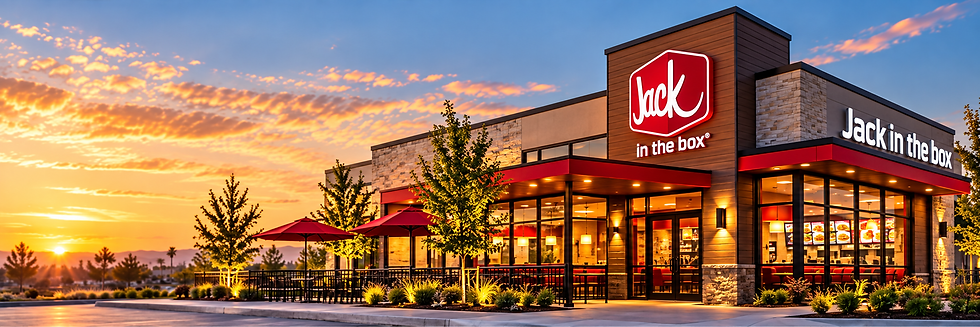
The physical real estate can materially influence both buyer demand and residual value. Jack in the Box has long emphasized convenience and reports that drive-thru and takeout account for a substantial majority of its customer transactions, making access, circulation, visibility, ingress and egress, stacking capacity, and overall site functionality relevant considerations for many locations.
A well-positioned freestanding QSR parcel may provide investors with more than contractual rental income. Buyers may also consider frontage, traffic patterns, parcel size, parking, zoning, surrounding retail, nearby anchors, population and employment trends, highway proximity, redevelopment potential, and the site's suitability for another restaurant or commercial user.
This is why two Jack in the Box properties with similar rents and lease terms can attract different buyer responses. One may occupy a highly adaptable corner or retail pad with strong access, while another may have physical constraints that reduce alternative-use flexibility.
Owners considering a sale should therefore evaluate the building and land as seriously as the lease. Our broader guide to selling QSR Triple Net (NNN) real estate explains why restaurant properties require analysis of both the income stream and the underlying site.
How Does My Jack in the Box Lease and Guarantor Affect the Sale?
The actual guarantor and remaining lease term can materially influence pricing, financing, marketability, and the size of the buyer pool. Buyers generally want to understand exactly who is obligated to pay the rent, how long that obligation remains firm, and what happens at each renewal period.
This distinction matters because a recognizable national brand does not automatically mean that the parent company guarantees every lease. Depending on the individual property, the responsible tenant could involve a different corporate or franchise structure. Sellers should obtain and review the complete lease, amendments, assignments, guaranties, estoppels, and other relevant documents before marketing whenever possible.
Remaining lease term is another important consideration. A buyer may view ten years of firm contractual term differently from a shorter firm term followed by several tenant-controlled options. Options can provide potential future occupancy, but they are not identical to guaranteed remaining lease term.
Owners should evaluate the timing of a sale before the lease approaches a point where shorter remaining term begins limiting financing options or changing the likely buyer profile. For a deeper explanation, see how remaining lease term can affect NNN property value.
How Should a Jack in the Box NNN Property Be Marketed Nationally?
A Jack in the Box NNN property should be marketed to the buyer segments most likely to value its particular combination of tenancy, lease economics, real estate, location, and passive-income characteristics. Limiting marketing primarily to buyers near the property can unnecessarily restrict competition.
NNN buyers frequently purchase properties outside their home states, and 1031 exchange investors may search nationally because they are trying to satisfy specific requirements involving timing, price, income, financing, tenant profile, lease term, and risk. National exposure therefore matters not because more views automatically create a better price, but because a broader qualified buyer pool creates more opportunities to identify the buyer whose objectives best fit the property.
Highwater Partners combines traditional commercial real estate listing and broker outreach with targeted exposure to private investors, family offices, NNN investors, institutional buyers when appropriate, and 1031 exchange capital. Mercedes Shaffer's investor-facing presence through The Commercial Real Estate Deal Room adds another distribution and education channel beyond a conventional listing-only approach.
The objective is competitive qualified interest. When several credible buyers understand the opportunity and have the ability to close, the seller may have greater negotiating leverage over price, due-diligence periods, financing contingencies, closing structure, and other terms. The role of national exposure in an NNN property sale is therefore an important part of the seller's strategy.
When Should I Sell My Jack in the Box NNN Property?
The right time to sell depends on the property's lease, income, physical condition, market position, tenant situation, and the owner's objectives. An owner should evaluate these factors before a major lease event or property issue forces the timing decision.
Important considerations may include remaining lease term, an upcoming renewal decision, scheduled rent increases, expected capital needs, remodel obligations, property condition, changes in the trade area, financing conditions, or changes in the actual tenant or guarantor. Seller timing can also depend on whether resolving an identifiable issue before marketing could expand the buyer pool.
Jack in the Box's public disclosures show that the company operates a substantial franchised system and has recently focused on improving restaurant performance and franchisee profitability. Those facts reinforce why investors may examine the specific restaurant, tenant entity, lease, and real estate rather than underwriting solely from the national brand name.
Owners should examine the property while they still have strategic choices. Sometimes selling earlier can preserve access to buyers that favor longer lease duration. In other situations, completing a lease amendment, resolving deferred maintenance, documenting a rent increase, or waiting for another identifiable event may improve marketability. The answer should come from property-specific analysis rather than a universal rule.
What Triple Net (NNN) Sellers Often Miss
One of the most common mistakes is assuming that the brand name alone determines value. Buyers care about Jack in the Box recognition, but they will also investigate the actual guarantor, firm remaining lease term, rent schedule, lease obligations, financing characteristics, location, and underlying real estate.
Owners also sometimes treat renewal options as though they were guaranteed lease years. A buyer may distinguish sharply between firm contractual term and future options controlled by the tenant.
For restaurant real estate, the physical configuration deserves equal attention. Drive-thru circulation, curb cuts, signalized access, frontage, parking, parcel configuration, zoning, building age, remodel requirements, and adaptability to another user may influence the property's residual value.
Another overlooked issue is marketing reach. The eventual buyer could be hundreds or thousands of miles away, particularly when 1031 exchange capital is involved. A seller who exposes the asset only to a local network may never discover how a broader national buyer pool would value it.
Finally, owners can underestimate the importance of preparing for buyer objections before the property launches. Lease documents, tenant information, property records, maintenance history, surveys, environmental information, title materials, and clear explanations of unusual lease provisions can help reduce uncertainty and support a more controlled sale process.
Bottom Line
Selling a Jack in the Box Triple Net property successfully requires careful analysis of the actual guarantor, lease term and economics, drive-thru-oriented real estate, location, and residual property value, followed by exposure to the appropriate national buyer pool. Highwater Partners helps owners evaluate those variables, position the investment around its strongest characteristics, reach NNN and 1031 exchange buyers nationally, and preserve negotiating leverage throughout the transaction.
Frequently Asked Questions
How much is my Jack in the Box NNN property worth?
The value depends on more than the tenant's brand name. Buyers typically consider the actual lease guarantor, remaining firm term, rent and escalations, landlord obligations, location, site quality, financing environment, and underlying real estate. A property-specific valuation should analyze these factors together rather than simply applying a generic cap rate. Owners can also review the factors involved in determining what an NNN property may be worth.
Does the Jack in the Box name guarantee strong lease credit?
No. Brand recognition and lease-credit strength are separate issues. Because Jack in the Box operates and franchises restaurants, a seller should determine the exact entity named as tenant and the party, if any, guaranteeing the lease. Buyers and lenders may evaluate corporate, multi-unit franchise, regional franchise, and other guarantor structures differently.
Does the drive-thru increase the value of my Jack in the Box property?
A functional drive-thru can be an important real estate characteristic, but it does not automatically determine value. Buyers may consider access, stacking capacity, visibility, traffic, parcel layout, zoning, frontage, surrounding retail, alternative-use demand, and whether the configuration would remain useful to a future restaurant or commercial tenant.
Do 1031 exchange buyers matter when I sell?
Yes, 1031 exchange investors can represent an important buyer segment for NNN properties because many seek passive replacement assets with identifiable income and lease structures. These investors may search across multiple states rather than limiting themselves to their home market, which is one reason national marketing can expand the relevant buyer pool.
Should I sell before my Jack in the Box lease gets shorter?
Possibly, but the decision should be based on the individual property. As firm lease term declines, financing, buyer demand, and perceived renewal risk can change. Owners should evaluate the lease well before a renewal or expiration date so they can compare selling now, waiting, negotiating an amendment, or pursuing another strategy while multiple options remain available.
Why should I use a broker who specializes in NNN property sales?
NNN transactions require more than general property marketing. A specialized broker should understand guarantor analysis, lease economics, cap rates and valuation, 1031 exchange buyer behavior, financing considerations, residual real estate value, national investor outreach, and transaction structure. Owners can review the considerations involved in choosing a Triple Net (NNN) broker before selecting representation.
Related Triple Net (NNN) Resources
For owners evaluating timing as part of a broader disposition strategy, see when to consider selling a Triple Net (NNN) property.
Let’s Connect
Before deciding when, how, or at what price to bring a Jack in the Box NNN property to market, it can be valuable to understand how sophisticated buyers are likely to evaluate the lease, guarantor, income, site, and underlying real estate. Highwater Partners can help owners confidentially evaluate potential value, positioning strategy, sale timing, national marketing, and the buyer segments most likely to compete for the property.
About Mercedes Shaffer
Mercedes Shaffer is the Founder of Highwater Partners, a commercial real estate advisory firm specializing in Triple Net (NNN) investments, 1031 exchanges, multifamily investment properties, and single-tenant net lease real estate throughout the United States. Together with her brokerage platform, her team brings more than 250 years of combined commercial real estate experience and more than $18 billion in transaction experience.
Mercedes advises private investors, family offices, developers, and institutional investors on the acquisition, disposition, valuation, and exchange of investment real estate. Her expertise includes tenant credit analysis, lease structure, cap rates and valuation, 1031 exchange strategy, market and location fundamentals, and the evaluation of risk in Triple Net investments.
In addition to her advisory work, Mercedes is also the creator and host of the Commercial Real Estate Deal Room, an educational platform focused on helping investors understand Triple Net real estate, 1031 exchanges, lease and tenant risk, valuation, and the transition from management-intensive properties into more passive real estate investments.
Mercedes is known for an analytical approach that goes “beyond the cap rate” and the glossy brochure. Rather than evaluating an investment solely by its advertised yield or the name on the building, she examines the tenant, lease, underlying real estate, market fundamentals, exit strategy, and the investor’s broader objectives.
Her philosophy is straightforward: there is no universally “best” Triple Net property—only an investment whose combination of real estate, income, risk, and long-term strategy may or may not be appropriate for a particular investor. That perspective guides her work across acquisitions, dispositions, 1031 exchanges, and long-term investment strategy.