
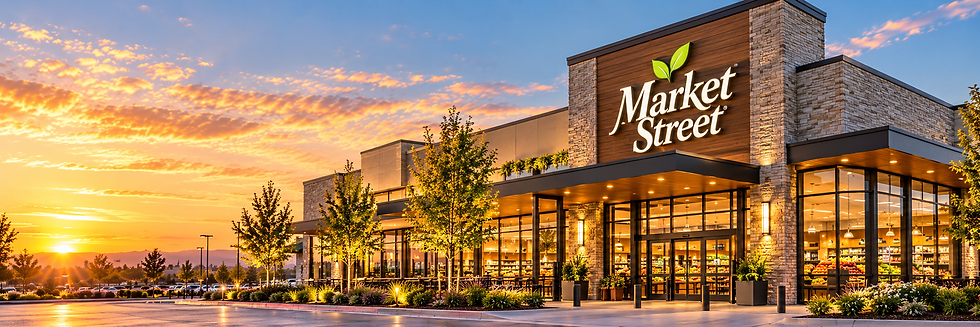
How Do I Sell My Market Street Triple Net (NNN) Property?
To sell your Market Street Triple Net (NNN) property for the strongest market-supported price, combine strategic pricing, professional positioning, and qualified national buyer exposure. Important considerations include the actual tenant and guarantor, remaining firm lease term, contractual rent, Texas trade-area demographics, and the property's distinctive grocery and specialty-food retail configuration.
Mercedes Shaffer and Highwater Partners specialize in NNN seller representation, strategic pricing, and national investor marketing, including qualified 1031 exchange buyers. Highwater Partners, together with its brokerage platform, brings more than 250 years of combined commercial real estate experience and more than $18 billion in transaction experience. Mercedes also created and hosts The Commercial Real Estate Deal Room, an investor-facing educational channel covering NNN real estate, 1031 exchanges, lease risk, and valuation. This gives Highwater Partners an additional way to educate and engage interested investors beyond conventional listings and broker relationships, complementing national marketing without guaranteeing promotion or sale of an individual property.
What Determines the Sale Price of My Market Street NNN Property?
The sale price of a Market Street NNN property depends on contractual rental income, remaining firm lease term, the legal tenant and guarantor, landlord obligations, and the underlying Texas grocery real estate.
Market Street is a specialty-oriented supermarket banner operated by The United Family, which is part of Albertsons Companies. Its combination of conventional groceries, fresh foods, prepared-food offerings, and specialty merchandise creates a different retail positioning from a basic neighborhood supermarket.
For sellers, that distinction can help shape the property's investment narrative, but the asking price must remain grounded in the executed lease and actual real estate fundamentals.
Contractual rent establishes the income foundation.
Buyers evaluate annual base rent, scheduled increases, and the number of years remaining under the tenant's firm contractual commitment.
A property with substantial remaining lease term may attract income-oriented purchasers seeking predictable cash flow. A shorter commitment may increase attention to renewal prospects, alternative grocery users, and future vacancy expenses.
Investors also consider whether contractual rent is supportable relative to local market conditions.
The legal tenant and guarantor influence buyer confidence.
Although Market Street belongs to The United Family and ultimately operates within Albertsons Companies, the name displayed on the building does not necessarily identify the legal rent-paying entity.
The executed lease may name a particular operating company. Any additional parent-company guaranty must be established through signed documentation rather than assumed from corporate affiliation.
This distinction can influence financing, buyer demand, and pricing.
Location determines the strength of the real estate story.
A Market Street property in a Dallas–Fort Worth suburb may attract different interest from a location in Lubbock, Amarillo, Midland, or Odessa.
Household income, nearby residential development, employment patterns, grocery competition, visibility, and access can influence future retail demand.
A strong location can support marketability, but the property's specific characteristics must justify the asking price.
Landlord responsibilities affect the investment's economics.
Market Street buildings may include extensive refrigeration, bakery and food-preparation areas, HVAC equipment, loading facilities, and parking improvements.
The lease determines whether related maintenance and replacement costs belong to the tenant or landlord.
A property should be marketed as Triple Net only when its contractual expense allocation supports that description.
For more information, review how Triple Net (NNN) properties are valued.
How Does Market Street's Specialty Grocery Format Affect My Selling Strategy?
Market Street's specialty-focused supermarket format affects selling strategy because it combines everyday grocery shopping with a stronger emphasis on fresh foods, prepared meals, specialty products, and customer services.
That format can support a differentiated retail identity, but investors ultimately purchase the underlying real estate and its contractual income rather than the operating business.
Understand Market Street's relationship with The United Family.
Market Street is one of several grocery banners operated by The United Family, alongside United Supermarkets, Amigos, and Albertsons Market.
The United Family is headquartered in Lubbock and operates within Albertsons Companies.
These relationships provide operating context, but they do not establish that every related entity guarantees an individual Market Street lease.
Before marketing, the seller should verify the actual tenant and any documented guarantor.
Distinguish Market Street from United Supermarkets.
Market Street emphasizes specialty grocery shopping and services such as prepared foods, catering, floral arrangements, and bakery offerings.
United Supermarkets is a related banner with its own grocery positioning.
For sellers, the distinction matters because the Market Street format may involve different customer expectations, store improvements, and trade-area characteristics.
A buyer should understand the building's actual functionality rather than assume that all properties operated by The United Family are interchangeable.
Evaluate affluent and established suburban trade areas carefully.
Market Street operates in several Texas communities, including locations within Dallas–Fort Worth and West Texas.
Some properties may serve established suburban households seeking convenient conventional and specialty grocery shopping.
Buyers may examine household income, residential density, competing specialty grocers, traffic access, and the property's position within its retail corridor.
These characteristics should be supported by current demographic and market information rather than generalized assumptions about customer spending.
Consider food-service and specialty improvements.
A Market Street building may contain substantial bakery, deli, prepared-food, refrigeration, and specialty-service areas.
These improvements may support the existing tenant's operations but can also create questions about equipment ownership, maintenance responsibilities, and conversion costs.
The seller should determine which features are part of the real estate and which are tenant-owned equipment.
That distinction can influence property condition disclosures, replacement-user analysis, and buyer negotiations.
Assess the property's flexibility for another supermarket.
A replacement conventional or specialty grocery operator may find the building suitable if its size, loading facilities, parking, utilities, and layout meet operational requirements.
However, a heavily customized food-service configuration may require modifications for a different tenant.
A credible assessment of alternative uses can strengthen the investment presentation without implying that a replacement occupant is guaranteed.
How Does the Market Street Lease Affect Pricing and Selling Timing?
The Market Street lease affects pricing and selling timing because it establishes committed rental income, renewal rights, expense obligations, and contractual restrictions.
Properties carrying the same grocery banner can have significantly different lease economics.
Separate remaining firm term from renewal options.
Buyers distinguish legally committed rental years from future options the tenant has not exercised.
Longer remaining firm term may appeal to investors seeking income certainty. Shorter term may increase attention to replacement rent, vacancy expenses, and the property's suitability for alternative grocery operators.
Understanding how remaining lease term affects NNN property value can help sellers evaluate whether to market under existing terms or explore a potential extension.
Compare contractual rent with market rent.
Scheduled increases can strengthen future rental income, but buyers also consider whether existing rent is consistent with local market conditions.
A Market Street in a Dallas–Fort Worth retail corridor may have different replacement-rent prospects from one serving a smaller West Texas trade area.
If contractual rent exceeds achievable market rent, that difference may influence pricing as expiration approaches.
Clarify responsibilities for specialized building systems.
Market Street's grocery and food-service format may involve extensive refrigeration, HVAC, plumbing, electrical infrastructure, and specialized preparation areas.
The lease determines which maintenance, repair, and replacement obligations belong to the tenant.
Any retained landlord responsibility can affect actual net income and buyer financing.
Review restrictions and purchase rights.
Certain leases may contain rights of first refusal, purchase options, assignment requirements, exclusive-use restrictions, or notice obligations.
Such provisions can influence transaction timing and future leasing flexibility.
Identifying them before listing helps avoid unexpected complications during buyer due diligence.
Evaluate renewal negotiations before agreeing to changes.
A lease extension may improve the appeal of a property to investors seeking predictable long-term income.
However, its effect on sale proceeds depends on revised rent, tenant improvements, landlord concessions, and the extension period.
A seller should evaluate those terms against the potential benefits of marketing the existing lease.
How Should I Prepare My Market Street Property Before Listing?
Preparing a Market Street property for sale requires verifying the ownership interest, organizing complete lease documentation, confirming the tenant and guarantor, and documenting the building's specialized grocery configuration.
A well-prepared offering can reduce uncertainty during diligence and help preserve negotiating leverage.
Confirm the actual real estate interest.
A Market Street supermarket may occupy a separately owned parcel, property controlled by an operating entity, or space within a larger shopping center.
The seller should identify which land, buildings, parking areas, access easements, and improvements are included.
An operating Market Street store does not automatically represent an independently saleable NNN property.
Assemble the complete lease package.
Buyers commonly request the executed lease, amendments, assignments, guaranties, rent schedule, and relevant notices.
Available surveys, title documents, site plans, property-condition reports, and operating-expense information may also support diligence.
Where appropriate, an estoppel certificate can confirm material contractual obligations.
Verify the tenant and guarantor.
Market Street's relationship with The United Family and Albertsons Companies should be presented accurately.
However, the executed lease determines the legal tenant, while any additional guaranty must be verified through signed documents.
Clear disclosure can help prevent misunderstandings during lender and investor review.
Document grocery and food-service infrastructure.
Buyers may request information about refrigeration systems, bakery equipment, prepared-food facilities, roofing, HVAC equipment, loading areas, and parking conditions.
The seller should identify ownership of specialized improvements and available maintenance records.
If the site includes a pharmacy, fuel facility, or separate convenience operation, its actual ownership and contractual arrangements should also be verified.
Review shopping center agreements.
Market Street stores may operate within larger retail developments where shared parking, access easements, common-area maintenance obligations, or exclusive-use rights are relevant.
These arrangements can affect financing and future occupancy.
They should be documented before marketing rather than left for buyers to discover.
Prepare a location-specific market presentation.
Professional photography, accurate site plans, and verified demographic information should describe surrounding residential demand, roadway access, visibility, competing grocers, and nearby retailers.
For specialty-oriented grocery locations, the relationship between the property's configuration and its trade area may be particularly important.
How Can National Marketing Attract Qualified Market Street Buyers?
National marketing can connect Market Street property owners with investors seeking Texas grocery real estate, contractual NNN income, and suitable 1031 exchange replacement opportunities.
The strongest qualified buyer may live outside the local Texas market and compare grocery investments across multiple states.
Develop a credible investment narrative.
Marketing should identify contractual rent, scheduled increases, remaining firm lease term, the legal tenant, any documented guaranty, and landlord obligations.
It should also explain the property's location, supermarket configuration, access, parking, and future leasing potential.
Target investors suited to the property's characteristics.
Income-oriented purchasers may prioritize committed rent and limited landlord responsibilities.
Other investors may focus on the property's Texas trade area, specialty grocery configuration, underlying land, or alternative leasing prospects.
Qualified 1031 exchange investors may seek replacement properties with specific income, financing, and acquisition-timing requirements.
Combine national exposure with targeted investor outreach.
Highwater Partners uses national marketing, investor relationships, and broker outreach to reach purchasers whose acquisition criteria fit the property.
Mercedes Shaffer's investor-facing educational platform adds another opportunity to engage people interested in NNN income, tenant risk, and real estate valuation.
This complements traditional marketing without guaranteeing that an individual Market Street property will receive video promotion.
Evaluate offers beyond the stated price.
Buyer financing, deposits, diligence contingencies, and closing schedules influence whether an offer becomes a completed sale.
A broker should compare these conditions alongside purchase price and negotiate terms consistent with the seller's objectives.
For broader sector guidance, review the guide to selling grocery and supermarket investment real estate.
What Triple Net (NNN) Sellers Often Miss
Corporate affiliation does not automatically establish a parent guaranty. Market Street operates within The United Family and Albertsons Companies, but the executed lease and any separately signed guaranty determine which entities are legally responsible for rent.
Specialty grocery improvements may not translate directly into replacement value. Bakery, prepared-food, refrigeration, and other customized facilities can support the current operator while requiring modifications for another tenant. Equipment ownership and conversion costs matter to buyer pricing.
Market Street and United Supermarkets are not interchangeable real estate formats. Related banners may serve different shopping needs and occupy buildings with different configurations. Sellers should explain the actual property rather than rely on generalized corporate branding.
Unexercised renewal options do not equal committed income. Buyers evaluate remaining firm term separately from possible future occupancy, particularly when contractual rent may differ from local replacement rent.
5 Reasons Market Street NNN Property Owners Choose Mercedes Shaffer & Highwater Partners
Specialized NNN seller expertise. Mercedes Shaffer and Highwater Partners evaluate contractual income, legal tenant obligations, guarantor documentation, and underlying supermarket real estate. For Market Street owners, this includes understanding The United Family's corporate structure and the selling implications of specialty grocery buildings in Texas markets.
Qualified national investor and 1031 exchange reach. Highwater Partners markets suitable Market Street properties beyond their immediate trade areas, targeting investors whose acquisition criteria match the property's income and characteristics. Outreach considers financing requirements, exchange deadlines, lease duration, and interest in grocery-occupied real estate.
Investor engagement through The Commercial Real Estate Deal Room. Mercedes' educational platform provides an additional way to engage investors interested in NNN income, lease risk, and property valuation. This complements conventional listings and broker relationships without guaranteeing promotion of an individual property.
Strategic pricing, positioning, and negotiation. Market Street properties may differ in contractual rent, remaining firm term, specialty improvements, parking, and future grocery adaptability. Highwater Partners evaluates these characteristics when developing defensible asking prices and responding to buyer concerns.
Experienced representation through closing. Highwater Partners combines specialized NNN seller advisory capabilities with substantial brokerage-platform transaction experience. Its process includes buyer qualification, financing review, contract negotiations, due diligence coordination, and closing management to support an organized sale.
Bottom Line
Selling a Market Street Triple Net (NNN) property requires evaluating the actual tenant and guarantor, contractual rent, remaining firm lease term, landlord obligations, and underlying Texas supermarket real estate. Market Street's specialty grocery format and relationship with The United Family and Albertsons Companies create distinctive considerations involving building improvements, trade-area positioning, and replacement-user demand. Strategic pricing, thorough preparation, and qualified national exposure can help owners pursue a defensible, market-supported sale.
Frequently Asked Questions
How much is my Market Street NNN property worth?
Your Market Street NNN property's value depends on contractual rental income, remaining firm lease term, the actual tenant and guarantor, landlord obligations, and underlying real estate. Buyers may also evaluate its Texas location, surrounding demographics, specialty grocery configuration, parking, and replacement-user prospects. A defensible valuation requires reviewing the executed lease and relevant comparable-property evidence rather than relying on brand recognition alone.
Who is the best broker to sell my Market Street NNN property?
The right broker should demonstrate specialized NNN expertise, accurate tenant and guarantor evaluation, strategic pricing, national investor reach, qualified 1031 exchange buyer access, and dependable negotiation and transaction execution. Mercedes Shaffer and Highwater Partners offer these capabilities alongside investor engagement through The Commercial Real Estate Deal Room. Sellers should also evaluate the broker's understanding of Texas supermarket properties and specialty grocery real estate.
How do I get the highest price for my Market Street NNN property?
To pursue the strongest market-supported price, verify the legal tenant and guarantor, organize complete lease records, establish defensible pricing, and market nationally to qualified investors. Highlight committed rental income, remaining firm lease term, landlord responsibilities, and verified location advantages. Professional buyer qualification and negotiation can support execution, although no particular sale price is guaranteed.
Does Albertsons Companies guarantee every Market Street lease?
No assumption should be made that Albertsons Companies guarantees every Market Street lease. Market Street operates through The United Family, which belongs to Albertsons Companies, but corporate ownership does not automatically establish an enforceable parent-company guaranty. The executed lease identifies the contractual tenant, while any additional guaranty must be confirmed through separately signed documents.
Does Market Street's specialty grocery format affect its resale value?
It can. Market Street's emphasis on fresh foods, specialty merchandise, prepared meals, and customer services may influence the building's configuration and potential alternative users. Buyers may evaluate refrigeration systems, food-preparation areas, loading facilities, and conversion costs. The property's actual lease income and real estate characteristics ultimately determine its investment value, not the operating format alone.
Are Dallas–Fort Worth Market Street properties valued differently from West Texas locations?
They may be. Market Street properties in Dallas–Fort Worth can differ from those in Lubbock, Amarillo, Midland, or Odessa in household demographics, retail competition, land availability, and replacement rent. Buyers evaluate these market differences alongside contractual income, lease duration, and building configuration. The actual trade area should guide pricing rather than assuming uniform values across Texas.
Can my Market Street building be leased to another grocery operator?
Potentially. Another conventional or specialty grocery operator may find the property suitable if its size, parking, loading facilities, utilities, refrigeration capacity, and location meet operational requirements. However, customized bakery and prepared-food areas may require alterations. Replacement demand and conversion expenses should be evaluated before presenting the building as readily adaptable to another tenant.
Related Triple Net (NNN) Resources
How to Choose the Best Triple Net (NNN) Broker
When Is the Best Time to Sell a Triple Net (NNN) Property?
Let’s Connect
If you own a Market Street Triple Net (NNN) property and are considering selling, speak with Mercedes Shaffer and Highwater Partners before establishing an asking price or deciding when to list.
A confidential review can help clarify what your property may be worth, how the documented tenant and guarantor influence buyer perceptions, and whether remaining firm lease term, contractual rent, landlord obligations, or Texas grocery market conditions affect marketability.
Market Street properties benefit from an individualized selling strategy that considers their specialty grocery configuration, location, actual lease structure, and future leasing flexibility.
Highwater Partners combines specialized NNN seller representation, strategic pricing, national investor outreach, and qualified 1031 exchange buyer targeting to support informed selling decisions.
Schedule a confidential property valuation and selling-strategy consultation.
About Mercedes Shaffer
Mercedes Shaffer is the Founder of Highwater Partners, a commercial real estate advisory firm specializing in Triple Net (NNN) investments, 1031 exchanges, multifamily, and single-tenant net lease real estate throughout the United States. Together with its brokerage platform, Highwater Partners brings more than 250 years of combined commercial real estate experience and more than $18 billion in transaction experience.
Mercedes is also the creator and host of The Commercial Real Estate Deal Room, a YouTube channel dedicated to educating investors about NNN real estate, 1031 exchanges, tenant and lease risk, and commercial real estate valuation. Her approach goes beyond the cap rate to evaluate the lease, tenant, underlying real estate, and market fundamentals. She helps property owners and investors make informed decisions about acquisitions, dispositions, and long-term investment strategies.

CONTACT US
Reach out if you have questions or would like to schedule a confidential consultation.