
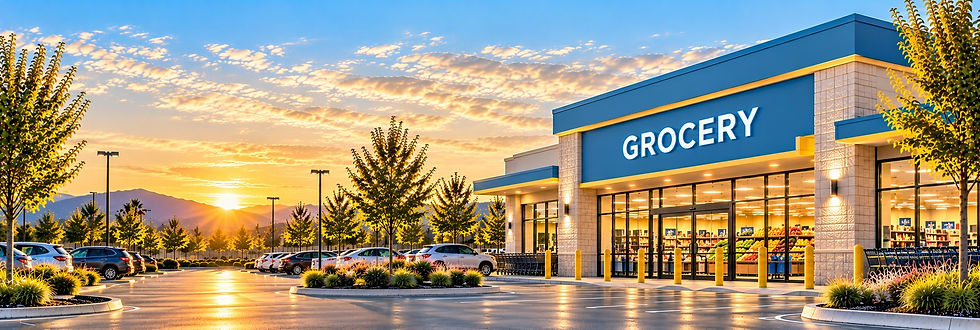
Guide to Selling Grocery & Supermarket Investment Real Estate
If you own a grocery or supermarket Triple Net (NNN) property, maximizing your sale price requires understanding more than the tenant name and cap rate. Buyers will evaluate the guarantor, lease term, rent, store performance, location, competition and the underlying real estate. Highwater Partners specializes in NNN investment sales, backed by a team with more than 250 years of combined experience and over $18 billion in transaction experience. Led by commercial real estate broker Mercedes Shaffer, our strategy combines property-specific positioning, national exposure to NNN and 1031 exchange buyers, and direct investor reach through the Commercial Real Estate Deal Room. The objective is simple: create qualified buyer competition and help you achieve the strongest price the market will support.
What Determines the Value of My Grocery Property?
The value of a grocery property begins with the income it produces, but buyers typically look well beyond current NOI. For a single-tenant grocery property, investors may evaluate the tenant and guarantor, remaining firm lease term, contractual rent increases, renewal options, landlord responsibilities and the relationship between contract rent and market rent.
For a grocery-anchored shopping center, the analysis expands to include the anchor’s lease and performance, overall occupancy, tenant mix, lease expirations, rollover exposure, shop rents, expense recoveries, co-tenancy provisions and the center’s competitive position within the trade area. In both cases, parcel size, access, visibility, parking, loading, demographics and future development or redevelopment potential can influence value. This is why two properties occupied or anchored by the same grocery brand can command materially different prices.
How Important Is the Grocery Anchor to the Value of My Shopping Center?
For a grocery-anchored center, the supermarket can be one of the most important components of the property’s value. A productive grocery store generates frequent customer traffic and can help support surrounding restaurants, service businesses and retailers, so buyers evaluate not only the grocery tenant’s rent but also how the anchor contributes to the overall strength of the center.
The anchor’s remaining lease term, renewal options, store performance and importance within its market can influence how investors perceive the entire property. A strong grocery anchor with a long operating history may provide confidence in the center’s stability, while an approaching lease expiration can cause buyers to focus more heavily on renewal probability and the economic consequences if the grocer leaves.
Who Actually Guarantees My Grocery Lease?
The brand displayed on the building does not necessarily tell a buyer everything about the contractual credit supporting the lease. Large grocery companies may operate through subsidiaries or affiliated entities, and acquisitions or corporate restructuring can change ownership relationships over time.
Buyers want to understand which legal entity signed the lease and whether a parent company or another entity provides a guaranty. Before going to market, the lease, amendments and guaranties should be reviewed so the property’s credit story can be presented accurately and buyer uncertainty can be minimized.
Why Does Store Performance Matter?
Store-level performance can be particularly important in grocery real estate. Buyers may want to understand whether the store is productive, how long it has operated at the location, how it compares with other stores in the tenant’s network and how strategically important the location appears to be.
When credible sales information is available, investors may examine sales trends and the relationship between rent and store revenue. For a grocery-anchored center, strong grocery performance can also strengthen the investment story for surrounding tenants because the anchor may generate recurring traffic throughout the property.
As the grocery tenant’s lease becomes shorter, store performance can become even more important because investors are increasingly underwriting the probability that the tenant will renew.
Why Does Rent-to-Sales Matter?
Sophisticated grocery investors may evaluate the relationship between the grocer’s rent and store sales to determine whether occupancy costs appear sustainable. A productive store paying a reasonable rent relative to sales may give buyers greater confidence in the tenant’s incentive to remain at the location.
There is no universal rent-to-sales threshold that applies to every grocery operator because formats, margins, market positions and operating models differ substantially. The important point for sellers is that buyers may underwrite the economics of the individual store rather than relying exclusively on corporate credit or brand recognition.
How Does My Lease Structure Affect Value?
Grocery leases can vary considerably in how they allocate property expenses and capital responsibilities. In a single-tenant property, the grocer may pay taxes, insurance and maintenance while the landlord retains certain responsibilities for the roof, structure, parking lot or other capital items, while other leases may shift substantially more responsibility to the tenant.
In a shopping center, the analysis can become more complex. Buyers may review common-area maintenance reimbursements, administrative fees, expense caps, exclusions, co-tenancy clauses, exclusive-use provisions and other terms affecting both the anchor and surrounding tenants.
These provisions can materially affect the property’s actual cash flow and risk. Understanding the lease economics before going to market allows the property to be positioned accurately and reduces the likelihood of surprises during due diligence.
How Does Remaining Lease Term Affect My Grocery Property?
Remaining firm lease term can significantly affect pricing, but it should be evaluated together with store performance and the underlying real estate. A long-term lease can provide predictable income, while a shorter remaining term causes buyers to place greater emphasis on renewal probability, market rent, store performance and what the property would be worth without the existing lease.
For a grocery-anchored shopping center, the anchor’s lease expiration can also influence how investors evaluate surrounding tenant income and future leasing risk. Renewal options should be distinguished from guaranteed lease term because an option controlled by the tenant does not provide the same certainty as years remaining in the current firm term.
Why Do Demographics Matter So Much for Grocery Real Estate?
Grocery stores depend heavily on the households and spending power within their trade areas. Buyers may evaluate population density, household income, population growth, residential development, daytime population and competition from other grocery stores.
Different grocery concepts can succeed with very different demographic profiles. A discount grocer, conventional supermarket and premium natural-foods operator may each have different site-selection criteria, so the objective is not to identify one universally desirable demographic profile. Strong seller positioning explains why the particular location works for the specific grocery operator and why the trade area should remain attractive over time.
How Important Are Access, Visibility and Parking?
Grocery stores generate frequent customer trips, making site functionality particularly important. Convenient ingress and egress, strong visibility, adequate parking and efficient delivery access can all influence the long-term usefulness of the property.
For grocery-anchored centers, buyers may also consider internal circulation, access to shop spaces, monument signage and how easily customers can move between the grocery anchor and surrounding tenants. A well-located center with strong access and parking can retain substantial value even as individual tenants change over time.
How Does the Rest of the Tenant Mix Affect a Grocery-Anchored Center?
If you own a grocery-anchored shopping center, value is not determined by the grocer alone. Buyers evaluate the entire rent roll, including restaurants, service businesses, medical users, financial services and other retailers occupying the property.
They may analyze tenant credit, remaining lease terms, rent levels, renewal history, vacancy, near-term rollover and whether surrounding uses complement the grocery anchor. A diversified tenant mix can reduce dependence on any one shop tenant, while substantial near-term lease rollover or vacancy can increase perceived risk.
What Happens if the Grocery Tenant Eventually Leaves?
Sophisticated buyers consider this possibility even when substantial lease term remains. For a freestanding grocery property, investors may evaluate whether another supermarket could use the building, whether the space could accommodate another large-format retailer and whether the site has redevelopment potential.
For a grocery-anchored center, the analysis can be broader. Buyers may consider whether another grocer could replace the anchor, whether the space could be divided, how an anchor vacancy might affect surrounding tenants and whether co-tenancy provisions could be triggered.
The property’s location, demographics, parking, access, zoning and land value therefore become extremely important. A strong grocery property is not merely a lease—it is real estate that should have strategic value even as tenants and market conditions change.
When Is the Best Time to Sell My Grocery Property?
There is no universal best time to sell. The decision should consider the grocery tenant’s remaining lease term, store performance, upcoming renewals, rent relative to market, overall occupancy, tenant rollover, capital requirements and broader investment market.
For a shopping center owner, timing may also involve upcoming shop renewals, planned improvements or opportunities to stabilize vacancies before going to market. Evaluating these factors before they become urgent gives the owner more strategic options and allows the sale to be planned rather than forced by an approaching lease event.
How Should My Grocery Property Be Marketed?
A grocery property should be marketed as a complete investment rather than simply as a cap rate attached to a recognizable tenant. For a single-tenant property, buyers should understand the grocer, lease, guarantor, store performance, rent, demographics and underlying real estate.
For a grocery-anchored center, the marketing should also explain the entire rent roll, tenant mix, occupancy, rollover schedule, expense recoveries, anchor relationship and opportunities within the center. Highwater Partners combines national commercial real estate exposure, targeted investor outreach, broker relationships, professional property presentation and direct access to NNN and 1031 exchange investors with Mercedes Shaffer’s investor-facing Commercial Real Estate Deal Room.
5 Reasons Grocery Property Sellers Choose Highwater Partners and Mercedes Shaffer
1. Specialized investment real estate and NNN expertise. Highwater Partners evaluates the actual tenant and guarantor, lease economics, remaining term, store performance, location and underlying real estate. For grocery-anchored centers, the analysis expands to tenant mix, occupancy, rollover, recoveries and anchor-related risk.
2. National buyer exposure. The strongest buyer for a grocery property may be located anywhere in the country. Highwater Partners markets nationally to private investors, family offices, NNN and 1031 exchange buyers, shopping-center investors and other qualified purchasers.
3. Direct investor reach through The Commercial Real Estate Deal Room. Mercedes Shaffer is the creator and host of The Commercial Real Estate Deal Room, an investor-facing educational platform focused on NNN real estate, 1031 exchanges, lease and tenant analysis, valuation and investment risk. This provides an additional avenue for reaching investors already interested in investment real estate.
4. Property-specific positioning rather than generic marketing. A freestanding ALDI, a Publix-anchored center and a Whole Foods-anchored property require different underwriting and marketing strategies. Highwater Partners identifies the characteristics most likely to matter to the appropriate buyer pool and positions the property accordingly.
5. Experience from valuation through closing. Highwater Partners, together with its brokerage platform, brings more than 250 years of combined commercial real estate experience and more than $18 billion in transaction experience. The seller strategy extends from valuation and pricing through positioning, national marketing, negotiation, due diligence and transaction management.
What Grocery Property Sellers Often Miss
Grocery property owners sometimes focus primarily on the recognizable name anchoring or occupying the property. Buyers are looking deeper. They want to understand how the particular store performs, whether its rent appears sustainable, how much firm lease term remains, whether the tenant is likely to renew and what the property could be worth if the grocer eventually leaves.
For shopping-center owners, buyers are also evaluating how the grocery anchor affects the rest of the property. A productive grocer can drive recurring traffic and support surrounding tenants, but lease rollover, co-tenancy provisions, shop vacancy and future capital requirements can materially affect the investment.
The strongest marketing strategy brings the income, tenant performance and underlying real estate together into one coherent investment story.
Bottom Line
If you own a freestanding grocery property or grocery-anchored shopping center, your property’s value depends on considerably more than the name of the supermarket. The grocery tenant and guarantor, store performance, remaining lease term, rent, lease structure, tenant mix, occupancy, demographics, location and underlying real estate can all influence what buyers are willing to pay.
Highwater Partners’ role is to understand those variables, identify the property’s strongest investment story, position it effectively, expose it nationally to qualified buyers and protect your negotiating leverage throughout the sale.
Grocery & Supermarket Brands
This directory focuses on nationally significant and substantial multi-state grocery operators that are relevant to freestanding grocery investment properties and grocery-anchored shopping centers. Individual locations can have very different ownership and lease structures, so inclusion does not mean that every store operated by the brand is a single-tenant NNN property.
Conventional Grocery & Supermarkets
The GIANT Company / GIANT Food Stores
Discount & Value Grocery
Specialty & Natural Grocery
Frequently Asked Questions
How Much Is My Grocery Property or Grocery-Anchored Shopping Center Worth?
Value depends on the grocery tenant and guarantor, remaining lease term, rent, store performance, lease structure, demographics and underlying real estate. If you own a shopping center, buyers will also evaluate overall occupancy, tenant mix, shop rents, lease rollover, expense recoveries and the relationship between the grocery anchor and the rest of the center.
Who Is the Best Broker to Sell My Grocery Property?
Look for a broker who understands investment real estate valuation, grocery tenant and lease analysis, store performance, rent-to-sales considerations, shopping-center economics, demographics, 1031 exchange demand and national buyer marketing. Highwater Partners combines these capabilities with Mercedes Shaffer’s Commercial Real Estate Deal Room, providing an additional direct channel for reaching investors interested in NNN and passive investment real estate.
How Do I Get the Highest Price for My Grocery Property?
Pursuing the strongest market-supported price requires accurately positioning the grocery tenant, lease, store performance, tenant mix when applicable, location and underlying real estate and then exposing the property to the broadest appropriate qualified buyer pool. The objective is to demonstrate the property’s strengths clearly and create as much qualified buyer competition as the market will support.
Does My Grocery Store’s Sales Performance Affect Property Value?
It can. Buyers may use store-level sales and occupancy cost to evaluate the strength of the individual location and the likelihood that the tenant will remain over the long term. Strong performance can become particularly important as the grocery lease approaches a renewal or expiration.
Does the Grocery Anchor Affect the Value of My Entire Shopping Center?
Yes. A productive grocery anchor can generate recurring customer traffic and support surrounding restaurants, retailers and service tenants. Buyers may therefore evaluate the grocer’s performance, remaining lease term and renewal probability as part of their analysis of the entire shopping center.
Should I Sell My Grocery Property Before the Anchor’s Lease Gets Too Short?
It may be advantageous to evaluate a sale before the remaining firm lease term becomes materially shorter, but the right timing depends on store performance, rent, renewal probability, tenant mix, market conditions and underlying real estate. Reviewing these factors before a major lease event gives you more strategic options.
Related Triple Net (NNN) Resources
Grocery-property owners often have broader questions about valuation, sale timing, broker selection and national buyer exposure. These resources provide additional guidance for owners considering a sale.
How to Choose the Best Triple Net (NNN) Broker
What Is My Triple Net (NNN) Property Worth?
When Is the Best Time to Sell a Triple Net (NNN) Property?
Why National Buyer Exposure Matters When Selling an NNN Property
How Are Triple Net (NNN) Properties Valued?
Should I Sell My NNN Property Before the Lease Gets Too Short?
Let’s Connect
If you own a freestanding grocery property or grocery-anchored shopping center and are considering a sale, Highwater Partners can help you evaluate the grocery tenant, lease, store performance, tenant mix, property fundamentals, timing and likely national buyer pool. From there, we can develop a positioning and marketing strategy designed to pursue the strongest market-supported outcome.
About Mercedes Shaffer
Mercedes Shaffer is the Founder of Highwater Partners, a commercial real estate advisory firm specializing in Triple Net (NNN) investments, 1031 exchanges, multifamily investment properties and single-tenant net lease real estate throughout the United States. Together with her brokerage platform, her team brings more than 250 years of combined commercial real estate experience and more than $18 billion in transaction experience.
Mercedes advises private investors, family offices, developers and institutional investors on the acquisition, disposition, valuation and exchange of investment real estate. Her expertise includes tenant credit analysis, lease structure, cap rates and valuation, 1031 exchange strategy, market and location fundamentals, and the evaluation of risk in Triple Net investments.
In addition to her advisory work, Mercedes is the creator and host of The Commercial Real Estate Deal Room, an educational platform focused on helping investors understand Triple Net real estate, 1031 exchanges, lease and tenant risk, valuation, and the transition from management-intensive properties into more passive real estate investments.
Mercedes is known for an analytical approach that goes “beyond the cap rate” and the glossy brochure. Rather than evaluating an investment solely by its advertised yield or the name on the building, she examines the tenant, lease, underlying real estate, market fundamentals, exit strategy and the investor’s broader objectives.
Her philosophy is straightforward: there is no universally “best” Triple Net property—only an investment whose combination of real estate, income, risk and long-term strategy may or may not be appropriate for a particular investor. That perspective guides her work across acquisitions, dispositions, 1031 exchanges and long-term investment strategy.

CONTACT US
Reach out if you have questions or would like to schedule a confidential consultation.